

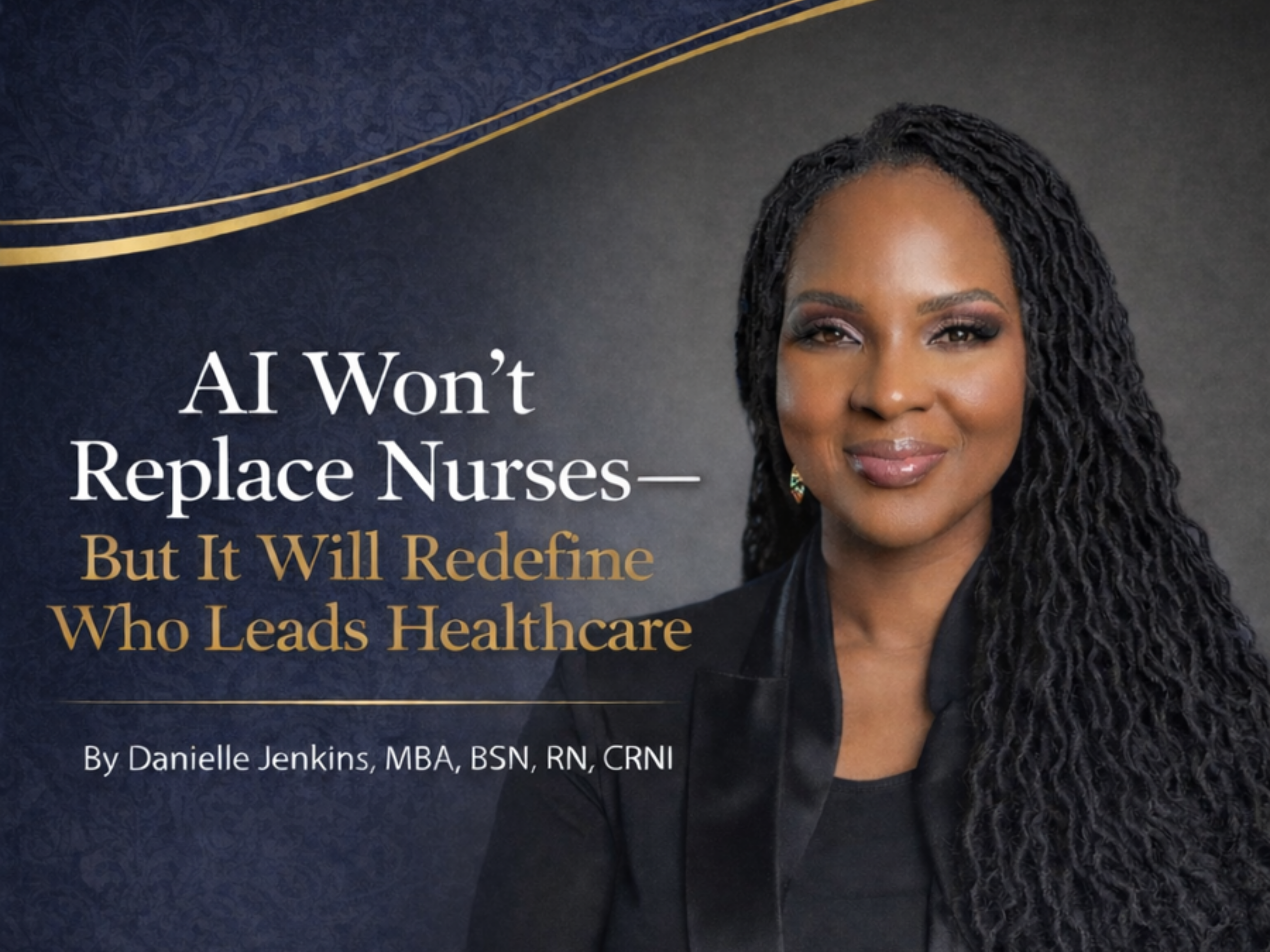
Let’s tell the truth—clearly.
Artificial Intelligence is not coming.
It is already here.
Quietly embedded in clinical workflows.
Silently influencing decisions.
Rapidly reshaping how care is delivered, documented, and measured.
From predictive analytics to automated documentation…
From virtual triage systems to AI-assisted diagnostics…
Healthcare is no longer evolving.
It is being reengineered.
And yet, one question continues to surface:
“Will AI replace nurses?”
No.
But that question is too small for the moment we are in.
The better question is:
What happens to a profession that does not evolve at the same pace as the systems around it?
AI Is Not the Threat—Irrelevance Is
AI does not eliminate value.
It exposes it.
Tasks that are repetitive, predictable, and rule-based will continue to be automated.
Not because nurses are replaceable—but because inefficiency is.
What remains—what becomes more valuable—is everything that cannot be reduced to an algorithm.
And that is where nursing either rises…
or gets reduced to execution.
Why Nurses Still Matter—More Than Ever
AI is powerful—but it is not clinical.
It does not carry responsibility.
It does not hold accountability.
It does not stand at the bedside when outcomes shift.
Clinical Judgment Is Not Data Processing
Nurses do not simply apply protocols—we interpret complexity.
We recognize patterns that are not yet measurable.
We sense decline before it becomes visible in data.
We make decisions in moments where ambiguity exists.
AI can analyze inputs.
Nurses synthesize reality.
Human Connection Is Not a Feature—It’s the Foundation
Healthcare is not purely transactional.
It is relational.
Patients don’t measure their experience in algorithms.
They measure it in trust.
In whether they were heard.
In whether someone advocated for them.
In whether someone saw them beyond their diagnosis.
No system—no matter how advanced—can replicate presence.
Advocacy Is Not Optional
Healthcare systems are complex, and often imperfect.
Nurses are the constant within that complexity.
We question when something doesn’t align.
We escalate when something doesn’t feel right.
We protect when systems fall short.
AI can flag risk.
Nurses take responsibility for it.
Ethics Cannot Be Automated
AI is trained on data.
But data reflects history—and history is not always equitable.
Bias exists.
Gaps exist.
Entire populations have been underrepresented.
Which means AI, if left unchecked, can scale inequity faster than it scales efficiency.
And when that happens—
It is not the system that will be held accountable. It is the clinician.
The Shift No One Is Talking About
The greatest risk is not that AI will replace nurses.
It is that nurses will remain positioned in roles that are easiest to replace.
For decades, nursing has been structured around task execution:
Documentation
Order implementation
Throughput efficiency
But AI is designed to optimize exactly those functions.
Which means the profession is now standing at a crossroads:
Remain task-driven—and become increasingly automated
or
Evolve into decision-makers—and become indispensable
From Bedside to Systems Thinking
The future of healthcare will not be led by those who only understand care.
It will be led by those who understand:
Systems
Technology
Data
Compliance
Business models
This is where the transformation happens.
Not at the level of tasks—but at the level of design.
Who designs the workflows?
Who determines how AI is integrated?
Who decides what “efficiency” means in a clinical setting?
If nurses are not in those rooms—
then nursing will be shaped by people who have never practiced it.
A Profession Being Redefined in Real Time
This is not about replacement.
It is about repositioning.
The nurses who will thrive are not just clinically strong.
They are:
Systems thinkers
Strategic leaders
Builders of care models
Influencers of policy
Translators between technology and patient care
They understand that the future of nursing is not limited to the bedside.
It expands into ownership, leadership, and innovation.
What I’ve Observed in This Shift
Working with nurses across the country, one pattern is clear:
Some are waiting for clarity.
Others are creating it.
The ones who are advancing are not necessarily the most experienced clinically.
They are the ones asking different questions:
How does this system work?
Where are the gaps?
Who is making these decisions—and why?
How can I influence this process?
They are not just participating in healthcare.
They are learning how it is built.
The Awakening
AI is not the moment.
This is.
A moment where nursing must decide:
Will it remain a profession defined by execution…
Or evolve into one defined by leadership?
Because the reality is:
The more healthcare becomes driven by technology,
the more it will require leaders who understand both humanity and systems.
And no profession is more positioned for that intersection than nursing.
Final Thought
AI will not replace nurses.
But it will force a distinction:
Between those who adapt…
And those who are adapted around.
Between those who lead…
And those who are led.
The future of healthcare is being built right now.
The only question that remains is:
Where will nurses stand within it?